

Two Babies and a Guidebook
When you can't turn down a dream assignment, the twins come along for the ride.


Hello, writer friend! Today we have the very first Wild Writing guest essay. I am thrilled to be opening this space to fellow writers, to share more perspectives from different corners of the world, allowing us all to explore those places and ideas together.
If you are interested in stories about place, nature, and the complicated web of the writing industry that we must navigate each day, consider becoming a paid subscriber. For just $45/year or $5/month, you’ll help me pay more writers and create more space for the kind of place-based, narrative stories that are harder and harder to find homes for.
Thank you for being here! 💚
Two Babies and a Guidebook
By Chantae Reden
Eight years ago, my husband, Mo, and I moved to Fiji for “just” a two-year contract.
“I’m not ready to leave,” we’d say every few years, unwilling to say goodbye to the hearty “bula!” you hear everywhere you go, the perfect waves, technicolor coral reefs, and the view of the river winding through the forest just outside our apartment windows.
When the opportunity came to update part of Lonely Planet’s Fiji guidebook, I wished for a time machine to high-five my 19-year-old self. I’d combed every page of Lonely Planet’s Central America on a Shoestring before my first solo trip.
There was one—okay, two—problems: My twin 10-month-olds. They still breastfed every few hours, and getting out of the house was always a fiasco. Mo worked full-time and couldn’t come along. Taking them by myself would be impossible. I was clocking 25,000 steps or more per day for previous guidebook research trips! With the babies, I wouldn’t even be able to carry them both out of the hotel room if we were placed on the second floor. Despite this, I had a feeling that I’d regret not taking the assignment. A reason to go deeper into Fijian culture and share one of the destinations I love most? Who knew if I’d still be in Fiji for the next update opportunity?
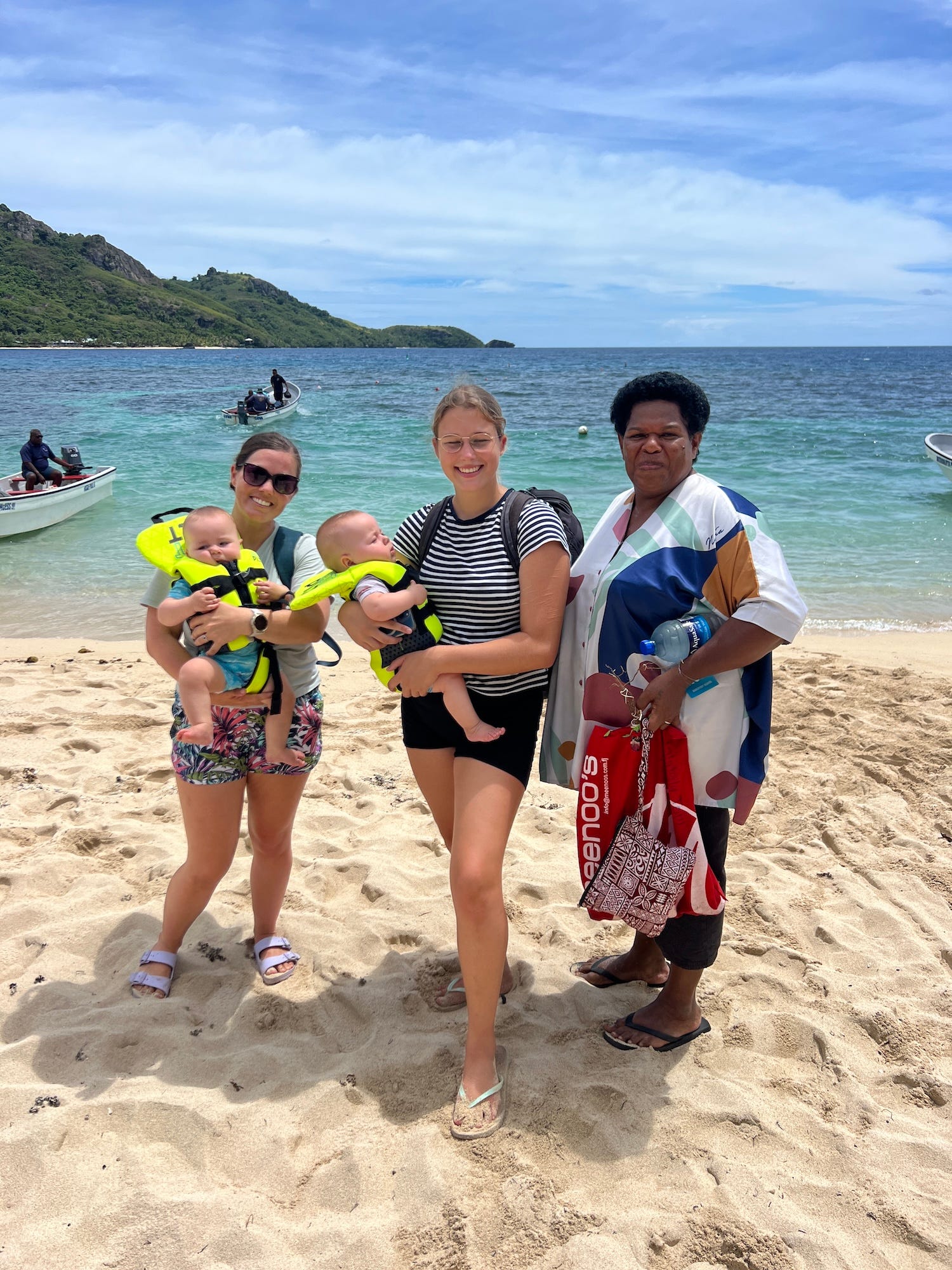
I recruited my teenage cousin-in-law, Rabea, and our Fijian nanny, Beta. We made our plan. For research trips within a few hours from home, I’d go alone. For any overnight stays or island hopping, they’d come along. Armed with bottles of pumped milk, they’d entertain the little ones and report on the accommodation’s pool and kids' club offerings while I ventured further afield.
On our first day, my car rumbled onto a ferry to the island of Ovalau, home to Fiji’s first official capital city and a UNESCO World Heritage site. Our trip, though long, was uneventful. But on the ferry’s return, it struck reef, stranding travelers on the island. There were too many tourists for available hotel rooms, leaving a surplus of people looking for places to stay. In Fiji, sharing everything is customary (strangers regularly offer a sip of soda or a bite of their sandwich on bus rides). Beta opened her room to a fellow traveler, and they laughed over shared plates of crab for dinner. When I wondered aloud how we’d get my car back to the island I lived on with the ferry firmly stuck on the reef, Ovalau residents urged me to relax. They’d figure it out, they said.
Ovalau is rich in Fijian history, with some villages stoic against outsiders. In 1871, village of Lovoni, for example, had its residents sold into slavery after the strongest men were lured from the village at the center of the island to a village on the coast for a feast, a false premise of reconciliation. Today, the people of Lovoni are interested in welcoming tourists, understandably on their terms.
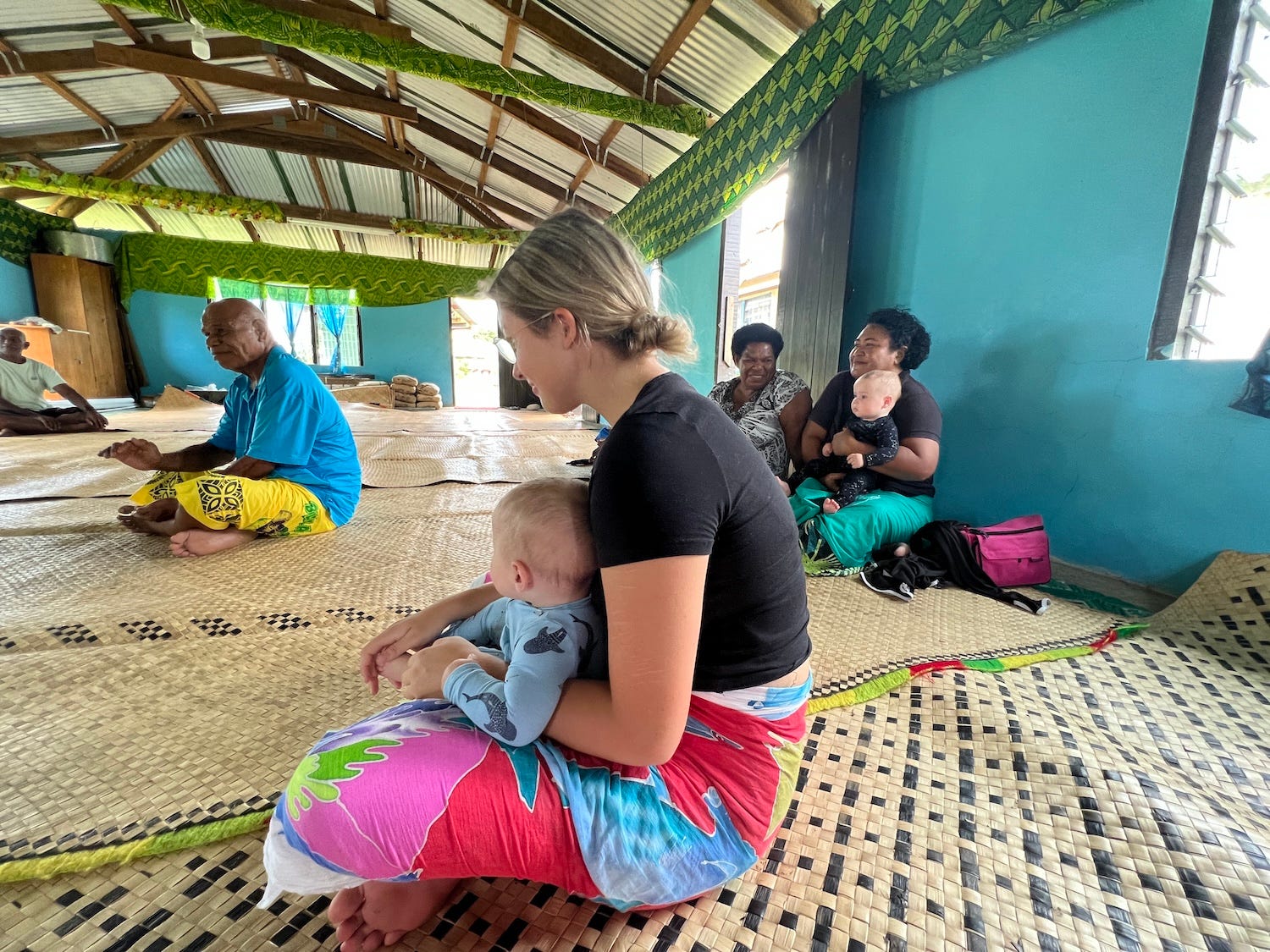
We entered villages with a baby in one arm and a bundle of yaqona (pepper roots that make a relaxing drink when ground and strained) in the other. The yaqona was presented as a sevusevu, a gift, and we were welcomed to a sevusevu ceremony with the village’s elders. The babies acted like chubby, cuddly icebreakers. The people we met told us stories as they smoothed woven mats for the babies to crawl on. Beta often had distant familial ties to the people we met, putting them instantly at ease. She also translated many phrases I didn’t understand, usually ceremonial proceedings and stories from elderly folks who were more comfortable speaking in Fijian. Rabea kept an ever-present eye on the little ones while I dedicated my attention to the research.
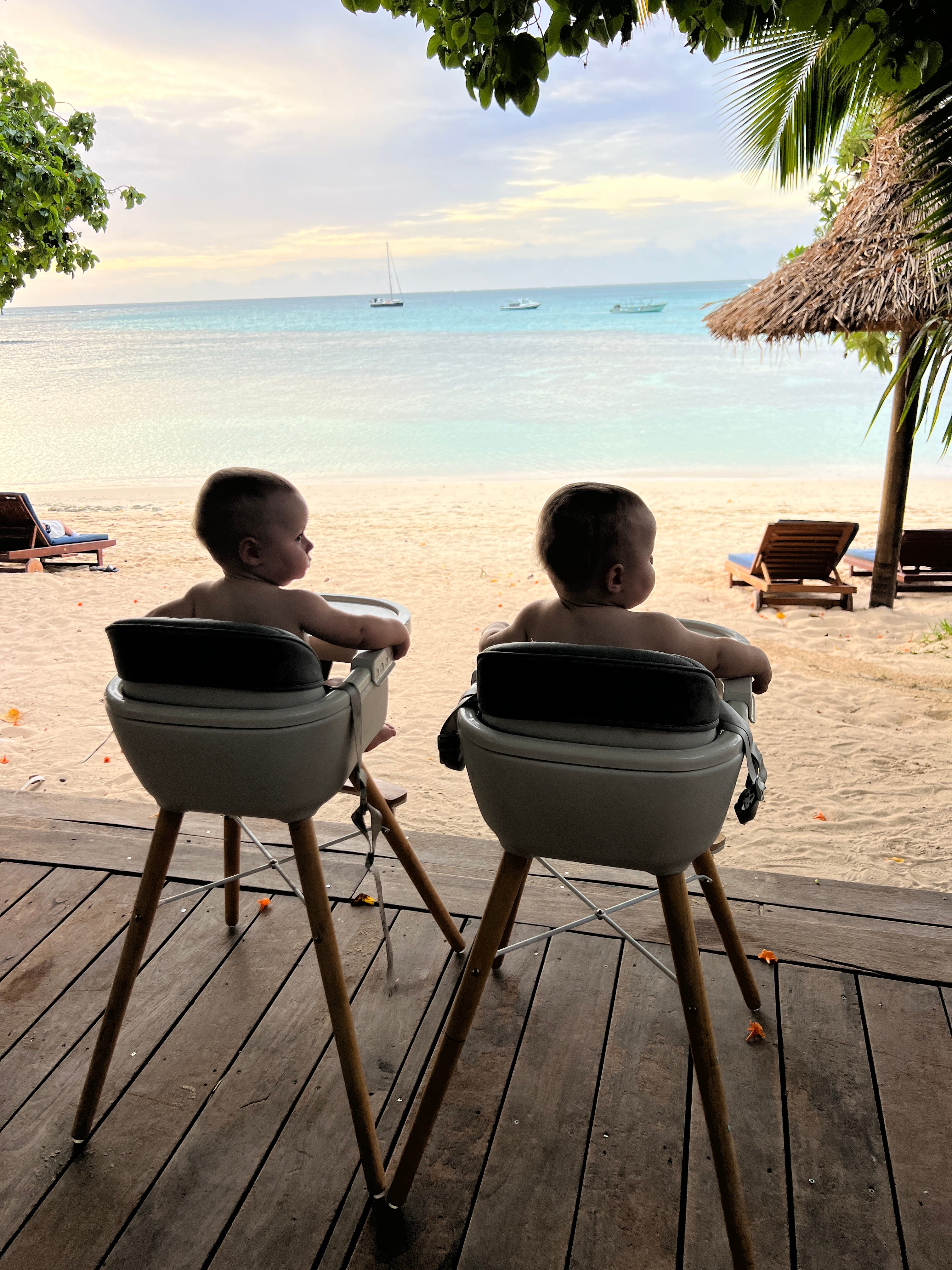
“They tried dragonfruit today—their 75th food!” Rabea told me as I tallied up the features of competing hotels.
On the day of departure, a few Ovalau residents came to my hotel just before sunrise. They handed me a hard-to-get ticket for an alternative ferry company back to my island. They stuck with us, ensuring I reversed my car onto the ferry without damaging it (or the other vehicles), and checking that Rabea, Beta, and the babies walked on safely. We passed our initial ferry, still on the reef, as we cruised back home.
In some ways, it was easier to travel with the babies than without them. Yes, we had some truly horrendous nights where our safari glamping tent's thin canvas was no barrier to their hourly screams. Every resort guest went for a second round of coffee the next morning. A deep maternal guilt followed me as I waved goodbye to go on a hike or scuba dive.
But the babies were treated like royalty everywhere we went, so we were, too. Restaurant staff carried the babies on their hips while they served food and played with them while we unpacked suitcase after suitcase. For the best shot at a full night’s sleep, we packed their portable cribs, sound machines, and sleep sacks. We even brought their double strollers. My former carry-on-only self would’ve never believed it. Rabea, the twins, and I shared one hotel room while Beta had another. On the rare instances we were all supposed to be in one large room, Beta often befriended hotel staff who nudged her into a spare hotel room. That’s the island connection!
I still haven’t done the accounting of how much, if any, profit I’d turned during my babies’ first year. I tried to think of the year as a makeshift maternity leave where it was Take Your Kids to Work Day, every day.
I have so many memories with the twins, Rabea, Beta, and my husband when he got the chance to come along, that I wouldn’t have made if I had done the trip solo. I’m grateful that despite being over 5,500 miles away from my family, I’ve found a village in Fiji.
I’m writing this from a hotel room on Moorea, researching the next edition of Moon Tahiti & French Polynesia. It’s just me this time. My twins are now 15 months old and have a freezer supply of milk I’d left in preparation, but the maternal guilt is omnipresent. I take pictures of beaches without intercepting a baby’s fistful of sand into his mouth (how are they so fast?). I breeze through airports with my single suitcase. I check in and out of hotel rooms without finagling with portable beds. Mo texts me whenever the babies wake up or go to sleep, and I tune in on the baby monitor app.
Writing, freelancing, content creation (whatever we’re doing these days) all call for agility. So does parenting. So does travel. Juggle all three, and it’s less a graceful dance and more a clumsy parkour routine with creaky knees and no warm-up. I don’t know the right way forward, only that there is one.
Chantae Reden is an adventure writer and guidebook author living in Fiji.
 | A guest post by
|
Wonderful essay and what an unforgettable experience! There will be more to come.
You are quite amazing Chantae!!💖